


Augusta Precious Metals
Education-first · High ratings
You can buy gold in an IRA only through a self-directed IRA that accepts IRS-eligible bullion — standard Fidelity, Vanguard, or Schwab IRAs hold gold ETFs (GLD/IAU), not depository bars. Use a trustee-to-trustee transfer, buy .995+ bars or approved coins (American Eagles excepted), and store metal at Delaware Depository, Brink’s, or IDS — never at home (McNulty).
Side-by-side fees, buy-ins, and promo fine print — confirm terms before you fund.
| Rank | Company | Rating | Fees | Minimum | Offer | Action |
|---|---|---|---|---|---|---|
| #1 | Low transparent fees | $50,000 | Free education + onboarding | |||
| #2 | Competitive annual fees | $25,000 | Popular free kit | |||
| #3 | Flexible fee options | $10,000 | Lower minimums | |||
| #4 | Standard custodian fees | $20,000 | IRA & physical options | |||
| #5 | Setup often waived* | $10,000 | Fast account setup |



A gold IRA is a self-directed IRA that lets you hold IRS-approved physical gold — and other precious metals — as part of your tax-advantaged retirement savings. Unlike a traditional IRA at Fidelity, Vanguard, or Schwab that typically holds stocks, bonds, and mutual funds, a self-directed IRA (SDIRA) allows direct ownership of physical bullion bars and coins that meet IRS fineness standards.
With a gold IRA, you can invest in gold bullion bars (minimum 0.995 fineness), American Eagle coins, Canadian Maple Leaf coins, and other approved precious metals including silver, platinum, and palladium. Investors use precious metals IRAs primarily for three reasons: (1) portfolio diversification beyond correlated stock/bond assets, (2) an inflation hedge — gold gained 25% in 2022 when CPI hit 9.1% while the S&P 500 fell 18%, and (3) reduced exposure to market volatility during recessions and geopolitical crises.
Three gold IRA structures exist: Traditional (pretax, $7,000/$8,000 limit for 2026, RMDs at 73), Roth (after-tax, tax-free qualified withdrawals, no lifetime RMDs for the original owner), and SEP (self-employed, higher employer-driven cap).
Pick Traditional for a possible current-year deduction, Roth if you expect higher future tax brackets, SEP if you run a business with eligible earned income. SIMPLE IRAs have extra timing rules (often a 2-year period) before some tax-free moves.
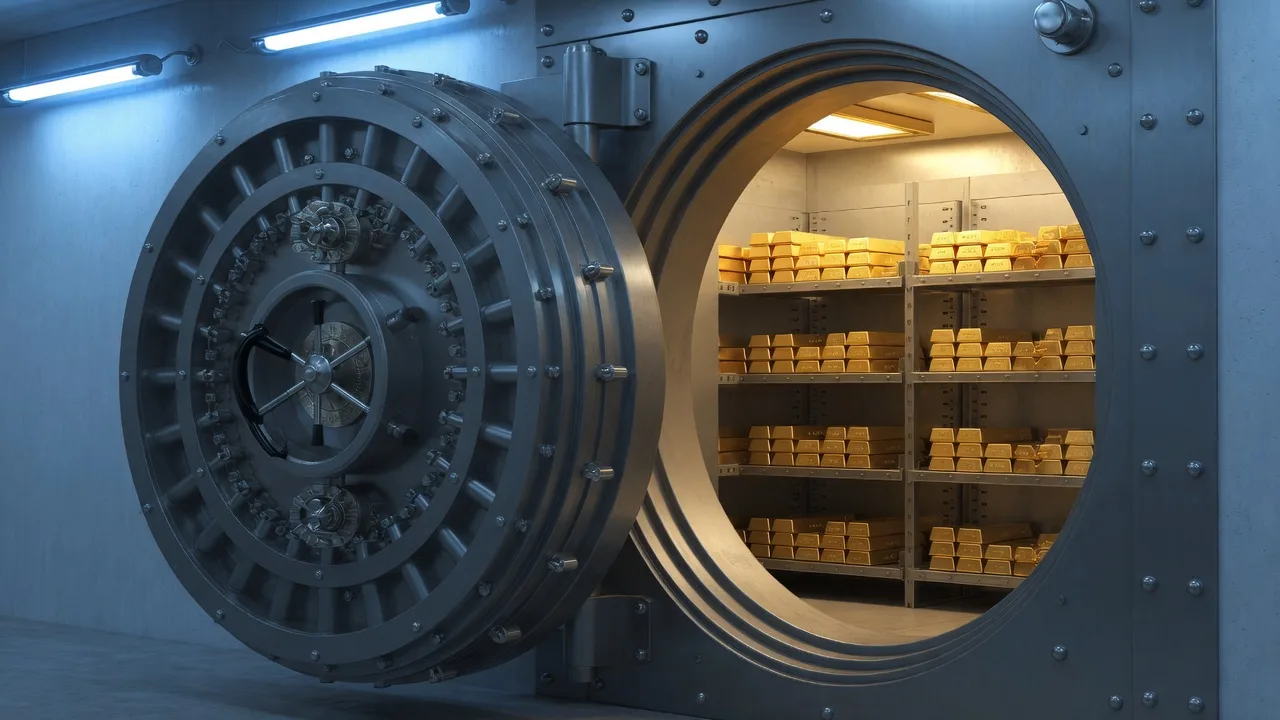
Yes — you can hold physical gold in a traditional IRA, but only through a self-directed IRA (SDIRA) with an IRS-approved custodian. Standard traditional IRAs at Fidelity, Vanguard, or Schwab do not permit physical precious metals; they allow only gold ETFs (like GLD or IAU) or gold mining stocks.
To buy actual gold coins or bullion in a traditional IRA: (1) open a self-directed IRA with a specialized custodian such as Equity Trust or GoldStar Trust, (2) fund it via a direct rollover from a 401(k)/403(b) or annual contribution, and (3) purchase only IRS-approved metals — gold must meet a 0.995 fineness minimum for bars or qualify as government-issued legal tender (e.g., American Eagle coins, which are exempt from the fineness rule under IRC Section 408(m)(3)(A)). The IRS prohibits home storage of gold IRA metals and requires your custodian to ship all physical bullion directly to an IRS-approved depository such as Brink's or the Delaware Depository (IRS Publication 590-A).
Fidelity does not offer physical gold IRA accounts. Through Fidelity, you can buy gold ETFs (GLD, IAU, SGOL), gold mining stocks, and gold mutual funds inside a standard IRA. For physical gold ownership, you need a separate self-directed IRA with a specialized custodian. Some investors maintain both: a Fidelity IRA for stocks/bonds and a self-directed gold IRA for physical metals.
Your gold IRA cannot hold numismatic coins, collectibles, or jewelry under IRC §408(m) — stick to government bullion coins and LBMA-refiner bars meeting fineness rules (American Eagles excepted).
The IRS permits four metals — gold, silver, platinum, and palladium — each subject to strict fineness minimums before qualifying for IRA inclusion.
| Metal | Minimum Fineness | Popular IRA-Eligible Products |
|---|---|---|
| Gold | 0.995 (99.5%) | American Eagle, Canadian Maple Leaf, Austrian Philharmonic, PAMP Suisse bars |
| Silver | 0.999 (99.9%) | American Silver Eagle, Canadian Silver Maple Leaf, 10 oz silver bars |
| Platinum | 0.9995 (99.95%) | American Platinum Eagle, Canadian Platinum Maple Leaf |
| Palladium | 0.9995 (99.95%) | Canadian Palladium Maple Leaf |
The IRS excludes numismatic coins, collectibles, and jewelry from gold IRAs regardless of metal content (IRC §408(m)(2)); only government-issued bullion coins and LBMA-approved refiner bars meeting minimum fineness standards qualify. American Eagle coins are a notable exception to the fineness rule — they are 0.9167 fine (22-karat) but explicitly approved by Congress under IRC Section 408(m)(3)(A).
For 2026, you can contribute up to $7,000 to a gold IRA annually — or $8,000 if you are age 50 or older (the $1,000 catch-up provision). The IRS applies a single combined $7,000 contribution cap across every IRA you own — not per account — as defined in IRS Publication 590-A.
| Account Type | 2026 Limit (Under 50) | 2026 Limit (50+) | Notes |
|---|---|---|---|
| Traditional/Roth Gold IRA | $7,000 | $8,000 | Combined limit across all IRAs |
| SEP Gold IRA | 25% of comp or $69,000 | 25% of comp or $69,000 | Employer contributions only |
| Rollover (401k/IRA) | No limit | No limit | Tax-free if direct transfer |
The most tax-efficient way to fund a gold IRA above the $7,000 annual cap is a direct rollover (trustee-to-trustee transfer) from a 401(k), 403(b), or existing IRA — rollovers have no dollar cap and generate no 1099-R withholding. With an indirect rollover, you receive the funds personally and must redeposit 100% within 60 days or the shortfall is treated as a taxable distribution plus a 10% early withdrawal penalty if under age 59½.
Opening a gold IRA takes four steps: choose a custodian, fund the account, select IRS-eligible metals, and arrange storage at an approved depository.
Step 1: Select a Specialized Custodian. Your custodian acts as the IRA trustee, handles IRS paperwork (Form 5498 and 1099-R), and coordinates with the depository.
Step 2: Fund the Account. Open your self-directed IRA and fund it via direct rollover from a 401(k)/403(b)/existing IRA (no dollar limit, no tax impact) or annual contribution (up to $7,000/$8,000 in 2026).
Step 3: Purchase IRS-Approved Metals. Select gold bars (0.995+ fineness), American Eagle coins, Canadian Maple Leafs, or other eligible products. Verify pricing against the current gold spot price — dealer premiums typically run 3-8% above spot.
Step 4: Arrange Depository Storage. IRS regulations mandate that your gold IRA custodian transfer all physical metals directly to an approved depository — home storage triggers immediate distribution treatment and tax penalties. Choose between segregated storage (your metals stored separately) or commingled storage (pooled with other investors, typically lower cost).
A gold IRA typically costs $200–$500 in year one and $150–$350 annually — fees include setup, maintenance, storage, and a 3–8% dealer premium above the gold spot price.
Expect four cost layers:
(1) Account setup fee: $50–$150 one-time, charged by the custodian to open your self-directed IRA.
(2) Annual maintenance fee: $75–$300/year for account administration, IRS reporting (Forms 5498, 1099-R), and recordkeeping.
(3) Storage fee: 0.5%–1% of assets annually, or a flat $100–$175/year, paid to the IRS-approved depository (e.g., Brink's, Delaware Depository). Allocated (segregated) storage — your specific bars stored separately with individual serial numbers — costs more than unallocated (commingled) storage but guarantees you receive your exact bars/coins upon distribution. Verify that your depository provides an assay certificate for each bar confirming fineness and weight.
(4) Dealer premium: 3–8% above the gold spot price (the precious metals dealer markup), charged on every purchase. The bid-ask spread on physical gold is wider than on ETFs — factor this cost into your total return calculation. Look for dealers whose bars carry LBMA-approved refiner or COMEX-approved hallmarks for maximum liquidity at resale.
| Company | Setup | Annual | Storage | Min. Investment |
|---|---|---|---|---|
| Augusta Precious Metals | $50 | $80 | $100/yr | $50,000 |
| Goldco | $50 | $80 | $100/yr | $25,000 |
| Birch Gold Group | $50 | $75 | $100/yr | $10,000 |
| American Hartford Gold | $0* | $75 | $100/yr | $10,000 |
| Noble Gold | $80 | $80 | $150/yr | $20,000 |
A $50,000 initial investment may carry $1,500–$4,000 in first-year total costs (including dealer premium) — factor this into return projections.
A gold IRA suits investors who (a) already hold 6+ months emergency cash, (b) have roughly $25,000+ available via contribution or rollover, and (c) want a 5–10% inflation-hedge sleeve — not a yield engine.
If you only want gold price exposure without physical delivery, a gold ETF such as IAU (~0.25% expense ratio) or GLD (~0.40%) inside a standard brokerage IRA is cheaper. If you want allocated physical bullion with IRS depository custody, pay the 3–8% dealer premium plus ~$100–$175 storage and accept multi-day liquidity.
Skip a physical gold IRA if your balance is under ~$10,000 (fees dominate) or you need cash within days.
Gold ETFs are cheaper (0.25% expense ratio, no storage fee) but represent paper claims on gold; gold IRAs hold allocated bullion with full IRS-recognized ownership but cost 5–10× more annually.
| Factor | Gold IRA (Physical) | Gold ETF (GLD/IAU) in Standard IRA |
|---|---|---|
| Annual Cost | $150–$350 + dealer premium | 0.25% expense ratio (e.g., IAU) |
| Ownership | Allocated physical bullion (your bars) | Paper claim on gold trust fund |
| Tax Treatment | Tax-deferred / tax-free (Roth) | Tax-deferred / tax-free (Roth) |
| Liquidity | 3–10 business days to liquidate | Instant (market hours) |
| Counterparty Risk | None (you own physical metal) | Trust fund and custodian risk |
| Min. Investment | $10,000–$50,000 | No minimum (share price ~$18–$200) |
For portfolios under $50,000, gold ETFs inside a Fidelity, Vanguard, or Schwab IRA typically deliver better net returns after fees. For portfolios above $100,000 where you want allocated physical metal with full ownership rights, a gold IRA makes economic sense.
Fidelity, Vanguard, and Schwab do not offer physical gold IRA accounts — they permit only gold ETFs (GLD, IAU, SGOL) and gold mining stocks inside standard IRAs.
These custodians are not licensed as self-directed IRA trustees under IRC §408(a). Physical gold IRA accounts require a specialized SDIRA custodian (Equity Trust, GoldStar Trust, Strata Trust) to handle IRS-required depository arrangements, assay certificates, and the Form 5498 reporting for alternative assets.
If you hold a gold ETF inside a Fidelity or Schwab Roth IRA, you benefit from low costs but do not own physical bullion. If physical ownership matters to you, open a separate self-directed IRA with a specialized custodian while keeping your Fidelity/Vanguard account for equities.
Gold returned approximately 5.5% annually over the past 20 years (LBMA PM fix data, 2005–2026) — below the S&P 500's ~10.5% annualized return but with near-zero equity correlation, making it a portfolio diversifier rather than a growth engine.
Historical Performance: A $10,000 investment in gold in 2005 would be worth approximately $73,000–$80,000 by early 2026, reflecting a 7–8x gain. A $1,000 investment in 2016 grew to roughly $2,600–$2,900 by 2026, a 160–190% return over 10 years. How much is 1 oz of gold right now? The gold spot price is approximately $4,130/oz as of April 2026 (LBMA PM fix), up from $1,800/oz in 2020 — a 69% gain. Retail 1-oz American Eagle coins trade $150–$250 above spot due to the 3–8% dealer premium and the bid-ask spread on physical bullion.
However, gold underperforms equities in bull markets — the S&P 500 returned approximately 10.5% annually over the same 20-year period versus gold's 5.5% annualized gain.
Gold IRAs carry four key risks: higher fees than standard IRAs, no dividend or interest income, price volatility, and liquidity constraints tied to depository release schedules.
Most financial advisors recommend allocating no more than 5–15% of a retirement portfolio to precious metals.
A gold IRA offers tax advantages and IRA legal protections; physical gold outside an IRA provides direct possession but no tax shelter and triggers capital gains tax at sale.
| Factor | Gold IRA | Physical Gold (Non-IRA) |
|---|---|---|
| Tax Treatment | Tax-deferred or tax-free (Roth) | 28% collectibles capital gains tax |
| Storage | IRS-approved depository required | Home safe, bank vault, or private vault |
| Access | Penalties before 59½; RMDs at 73 | Immediate, unrestricted |
| Annual Fees | $150–$350/year | $0–$150 (if using vault) |
| Creditor Protection | Federal bankruptcy protection | Varies by state |
| Insurance | Depository provides full coverage | Must arrange separately |
Gold ETFs (GLD, IAU) offer a third option: no storage hassle, instant liquidity, and low expense ratios (0.25–0.40%), but you do not own physical metal.
Your traditional gold IRA distributions count as ordinary income at your marginal rate in the year you take them; RMDs generally begin at age 73, and withdrawals before 59½ usually add a 10% penalty unless an exception applies.
Withdrawals before age 59½ trigger a 10% early withdrawal penalty plus ordinary income tax; required minimum distributions (RMDs) begin at age 73 for traditional gold IRAs.
Traditional Gold IRA: Contributions may be tax-deductible. All withdrawals are taxed as ordinary income. RMDs must begin by April 1 of the year after you turn 73.
Roth Gold IRA: Contributions are after-tax. Qualified withdrawals after age 59½ (and 5+ years) are completely tax-free. No RMDs during the owner's lifetime.
Prohibited Transactions & Disqualified Persons: Self-dealing with IRA gold — storing metals at home, using IRA gold as personal collateral, or purchasing metals from a disqualified person (you, your spouse, lineal descendants, or their spouses) — triggers immediate distribution treatment under IRC §4975. The entire IRA balance may be deemed distributed, resulting in full ordinary income tax plus the 10% early withdrawal penalty. A checkbook IRA or LLC-owned IRA structure does not exempt you from these prohibited transaction rules.
UBIT (Unrelated Business Income Tax): Most gold IRA investments are passive and not subject to UBIT. However, if your self-directed IRA uses debt-financing (leverage) to purchase metals, the leveraged portion of gains may be subject to Unrelated Business Income Tax (UBIT/UBTI) under IRC §514.
In-Kind Distributions: At age 59½+ or when taking RMDs, you may take an in-kind distribution — receiving physical gold bars or coins rather than cash. The fair market value on the distribution date is treated as ordinary income for traditional gold IRAs, reported on Form 1099-R.
Opening a gold IRA takes less than two weeks: choose a company, open and fund the account, select metals, and confirm depository storage.
A gold IRA must avoid prohibited transactions under IRC §4975. If you take personal possession of IRA metals or use them as loan collateral, the IRS can treat the account as distributed — creating ordinary income tax on the full balance plus a 10% early-withdrawal penalty if you are under 59½. You become a disqualified person when you self-deal with IRA property.
So-called “home storage gold IRAs” and checkbook LLC schemes marketed as personal vaulting frequently fail IRS standards. Your custodian must arrange shipment to an IRS-approved depository (examples used in the industry include Delaware Depository, Brink’s, and IDS). Keep assay/hallmark documentation with custodian records.
Related filings: custodians report contributions and year-end fair market value on Form 5498 and distributions on Form 1099-R.
Use a direct trustee-to-trustee (custodian-to-custodian) transfer whenever possible. Funds move between institutions without passing through your personal account, generally avoiding the 60-day deposit deadline and the one-rollover-per-12-months limit that applies to many indirect IRA rollovers.
An indirect rollover sends a check to you. You typically must redeposit 100% within 60 days or the shortfall becomes taxable. Employer plans (401(k)/403(b)) may withhold 20% on eligible rollover distributions paid to you — another reason direct transfers are preferred.
SIMPLE IRA note: many SIMPLE plans impose a two-year participation rule before certain tax-free rollovers to non-SIMPLE IRAs. Confirm with the plan administrator before initiating paperwork.
On a $50,000 account, first-year all-in costs commonly land near $600–$1,200 before metal price moves — depending on setup fees, custodial schedules, storage, and dealer spreads.
| Cost layer | Typical range |
|---|---|
| Account setup | $0–$150 one-time |
| Annual custodial / admin | $75–$300 per year |
| Depository storage | $100–$175 per year (segregated often higher than commingled) |
| Dealer premium / spread | ~3–8% over spot on many retail bullion purchases |
| Wire / transfer fees | $0–$50 (varies by banks/custodians) |
Ask every company for a written fee schedule and buyback spread before you transfer funds.
Your gold IRA cannot hold numismatic coins, collectibles, or jewelry under IRC §408(m) — stick to government bullion coins and LBMA-refiner bars meeting fineness rules (American Eagles excepted).
IRC §408(m) treats most collectibles as distributions, with a bullion exception for specified fineness levels produced by approved refiners/mints.
| Metal | Minimum fineness | Common IRA-eligible products |
|---|---|---|
| Gold | .995 (99.5%) for most bars | American Gold Eagle (statutory exception), American Buffalo, Canadian Maple Leaf, LBMA Good Delivery bars (PAMP, Valcambi, etc.) |
| Silver | .999 | American Silver Eagle, Maple Leaf, approved bars |
| Platinum / Palladium | .9995 | Certain Eagles / Maple Leafs meeting rules |
Generally prohibited: jewelry, most numismatic/collectible coins, and many proof products without qualifying bullion status. Confirm product eligibility with your custodian before purchase.
Your gold IRA stores metals at an IRS-approved depository under custodian control. Segregated (allocated) storage keeps your bars/coins identified separately — usually higher cost. Commingled storage pools like metals and is often cheaper.
Industry facilities frequently used with self-directed IRAs include Delaware Depository, Brink’s, and IDS. Request insurance coverage details and whether storage is allocated or unallocated before you fund the account.
Your traditional gold IRA distributions count as ordinary income at your marginal rate in the year you take them; RMDs generally begin at age 73, and withdrawals before 59½ usually add a 10% penalty unless an exception applies.
Traditional gold IRAs grow tax-deferred; withdrawals are ordinary income. Required Minimum Distributions (RMDs) generally begin at age 73 under current rules. Withdrawals before 59½ usually add a 10% early-withdrawal penalty unless an exception applies.
Roth gold IRAs use after-tax funding; qualified withdrawals can be tax-free and the original owner typically has no lifetime RMDs.
An in-kind distribution ships metal to you and is taxed on fair market value at distribution — reported on Form 1099-R. Beneficiaries should confirm designation forms with the custodian; rules differ for inherited IRAs.
Checkbook IRAs and LLC-owned “home storage” pitches frequently violate IRC §4975 prohibited-transaction rules when you, your spouse, or lineal descendants (disqualified persons) take personal control of IRA gold.
McNulty v. Commissioner (T.C. Memo 2021-06) shows the IRS/Tax Court will treat improper home storage as a distribution. Legitimate gold IRAs use a specialty SDIRA custodian and IRS-approved depository. UBIT/UBTI can also apply if the IRA uses debt financing to buy assets.
Paper gold ETFs cost roughly 0.25% (IAU) to 0.40% (GLD) annually with second-level liquidity; a physical gold IRA stacks setup, custodial, storage, and 3–8% spot-to-melt / dealer spreads.
Use ETFs for pure price exposure inside Fidelity/Vanguard/Schwab. Use a physical gold IRA when allocated bars, serial control (segregated storage), and in-kind distribution options matter more than expense ratio. LBMA Good Delivery and COMEX-approved refiners (PAMP, Valcambi, Perth, RCM) tighten resale spreads versus obscure hallmarks.
Update beneficiary designations with your gold IRA custodian — not only the metals dealer. An in-kind distribution ships physical metal and is taxed on fair market value (Traditional) reported on Form 1099-R. Outside an IRA, collectibles can face up to 28% capital gains; step-up in basis rules for inherited non-IRA metal differ from IRA inheritance rules — coordinate with a CPA.
Guides library
Deep-dive pages linked from our original guide index — rollovers, tax rules, and company reviews (restored from the public site map).
A gold IRA is a self-directed IRA that holds IRS-approved physical precious metals instead of (or in addition to) paper assets. Metals must be stored at an approved depository.
No. IRS rules generally require IRA precious metals to be held by a qualified trustee/custodian at an approved depository. Home storage can trigger taxes and penalties.
A direct trustee-to-trustee transfer or rollover from a 401(k)/IRA can fund a gold IRA without counting against annual contribution limits when done correctly.
Gold, silver, platinum, and palladium meeting minimum fineness standards (with certain government-minted coins exempted). Numismatics and jewelry generally do not qualify.
Typical costs include setup, annual account fees, storage, and dealer premiums over spot. Always compare total first-year and ongoing costs before opening an account.
A gold IRA can fit investors who want physical precious metals with tax-advantaged growth and already understand that gold pays no yield. Most advisors suggest a 5–15% portfolio allocation, not a core holding. Skip a gold IRA if your balance is under ~$10,000 (fees erode returns) or you need liquidity within days.
Roughly $10,000 of gold in mid-2005 (spot near $425/oz) would be worth about $95,000–$100,000 at ~$4,130/oz in July 2026 — roughly a 9–10× increase (World Gold Council price history). Past returns do not guarantee future results; gold also experienced multi-year drawdowns (e.g., 2012–2015).
Open a self-directed IRA with an IRS-approved custodian, fund it via contribution or trustee-to-trustee transfer, buy IRS-eligible bullion (.995+ gold bars or approved coins such as American Gold Eagles), and store metals at an IRS-approved depository (not at home).
Yes. Your custodian files Form 5498 annually for contributions and fair market value, and Form 1099-R for distributions. Cash purchases of physical gold outside an IRA above $10,000 can also trigger dealer Form 8300 reporting.
You can buy gold ETFs (e.g., GLD, IAU) inside standard Fidelity/Vanguard/Schwab IRAs. Physical depository bullion requires a self-directed IRA custodian and IRS-approved storage — not a standard brokerage IRA.
A checkbook or LLC structure that lets you control IRA metal personally often creates prohibited transaction risk under IRC §4975. Prefer custodian + depository custody; home storage has failed in Tax Court (McNulty).
Reader feedback
Independent reader notes from people researching gold IRA companies — not paid endorsements.
★★★★★Buy Gold In IRA made the rollover steps and fee tradeoffs much clearer before I requested any kits.
★★★★★The comparison table helped me shortlist providers without sales pressure.
★★★★★Straight explanations of IRS storage rules — exactly what I needed.

Jordan Hale, AIF®
Author · Accredited Investment Fiduciary

Morgan Lee, CFP®, EA
Reviewer · Certified Financial Planner & Enrolled Agent
We rank gold IRA companies on six weighted criteria: (1) fee transparency 25%, (2) IRS-compliance / product menu 20%, (3) buyback policy 15%, (4) minimum investment 15%, (5) custodian & depository partners 15%, (6) verified customer feedback / BBB-BCA record 10%. Rankings are editorially independent of affiliate compensation.
buygoldinira.us.com may earn a commission when readers request kits or open accounts via partner links (often labeled “Get kit”). Commissions do not change rankings, scores, or editorial conclusions.
Educational content only — not personalized investment, tax, or legal advice. Verify current fees and eligibility with your custodian and tax professional.

